Key takeaways
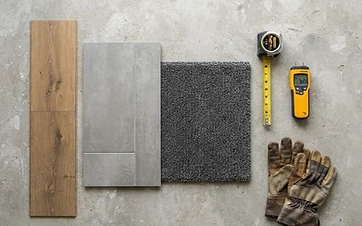
- LVP is the right default for living areas in a Las Vegas rental. Tile is the right default for bathrooms, laundry and entries.
- Both are waterproof. LVP is warmer, quieter and cheaper; tile lasts two to three times as long.
- Slab moisture testing decides whether either of them lasts. Skipping it voids most warranties.
These are the two floors that make sense in a Las Vegas rental, and the choice usually comes down to which room and how long you plan to hold the property. Here is the honest comparison.
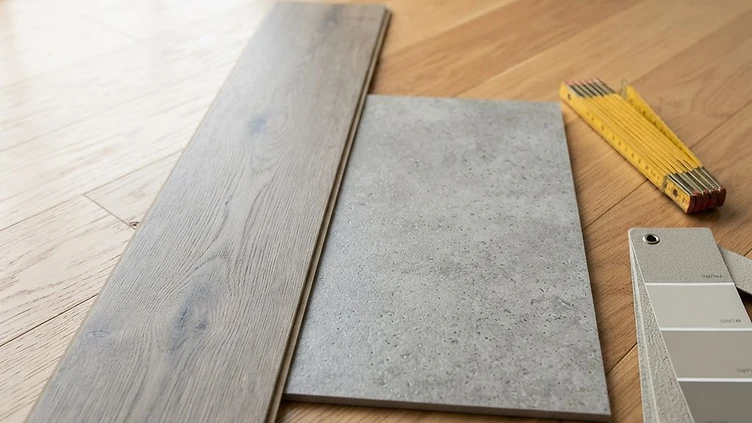
Head to head
| Luxury vinyl plank (LVP) | Porcelain or ceramic tile | |
|---|---|---|
| Installed cost | $3.50 – $6.00 / sq ft | $7.00 – $14.00 / sq ft |
| Lifespan in a rental | 7–12 years | 15–25 years |
| Water resistance | Waterproof | Waterproof |
| Comfort underfoot | Warm and quiet | Cold and hard |
| Repairing one damaged area | Single plank can be replaced | Single tile can be replaced |
| Installation time | 1–3 days for a 3BR home | 3–5 days plus grout cure |
| Grout maintenance | None | Grout needs sealing and cleaning |
| Noise | Absorbs some sound | Reflects sound — louder |
| Best for | Living, dining, kitchen, halls, bedrooms | Baths, laundry, entries |
How each one handles Las Vegas specifically
- Heat cycling. LVP expands and contracts with interior temperature swings but is dimensionally stable when installed with correct expansion gaps. Tile is unaffected by heat but the substrate beneath it is not — movement shows up as cracked grout or tenting.
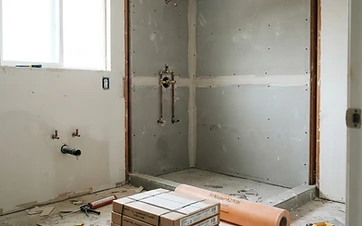
- Slab moisture. Both need a tested slab. LVP needs a compatible vapour barrier; tile needs a properly prepared and, in wet areas, waterproofed substrate.
- Hard water. LVP is impervious. Tile is too, but hard water leaves mineral deposits in grout lines that need regular cleaning.
- Dust. LVP in a mid-tone matte finish hides dust better than either dark plank or light tile.
- UV. Prolonged direct sun can fade cheap vinyl over years. Tile is unaffected.
The cost over a ten-year hold
LVP costs roughly half of tile to install, but you will likely replace it once in a ten-year rental. Tile costs more up front and is usually still there in twenty years. On a long hold, tile in the wet rooms and LVP everywhere else is the combination that costs least over time — which is exactly what we install on most of our own jobs.
The mistake that voids the warranty on both
Skipping slab moisture testing. Almost every LVP and tile warranty is void if the slab was not tested and the correct barrier or membrane was not installed. In Las Vegas, concrete slabs release moisture vapour year round. It is a 20-minute test.
What we recommend, room by room
- Living, dining, kitchen, hallways and bedrooms: LVP, mid-tone, matte finish
- Bathrooms, laundry and entryways: porcelain tile over a waterproofed substrate
- Pet-friendly units: LVP everywhere, including bedrooms
- Stairs: LVP with a matched stair nose, or carpet for noise control
What about carpet?
Carpet still has a place in bedrooms at the entry price point, where tenants expect softness and the cost difference matters. Use a solution-dyed fibre with a moisture-barrier pad, and budget for replacement every 3–6 years. Never put carpet in a pet-friendly unit.
What we typically see in Las Vegas homes
Based on our own repair work
From the floors we install and repair across the Valley:
- Lifting LVP seams are nearly always a subfloor problem, not a product problem. Grinding the high spots is what stops it recurring — we are called to fix this more than any other flooring complaint.
- Cracked grout in bathrooms is usually movement, not abuse. It almost always traces back to a substrate that was not properly prepared or a missing movement joint at the perimeter.
- We replace far more carpet than anything else, and almost always because of the traffic lane between the bedroom door and the bathroom rather than the whole room.
- In pet-friendly units, tile and LVP both survive; carpet does not. We have never seen a pet-friendly rental with carpet last a full tenancy.
A Henderson rental had LVP installed by a previous owner that was lifting and separating at the seams within a year, with the planks visibly tenting in the hallway.
Lifted the affected planks and found high spots in the subfloor at the panel seams and no vapour barrier over the slab. Tested the slab for moisture vapour, ground the high spots and patched the low spots to a level plane, installed a compatible vapour barrier, then reinstalled LVP throughout the affected area with correct expansion gaps at every perimeter wall, and replaced the baseboard, caulked and painted.
Henderson, NV