Key takeaways
- Three things have to match: texture, sheen and paint age. Miss any one and the repair reads as damage.
- A level-4 finish before texture is what stops the patch telegraphing through the paint.
- Sometimes a repair cannot be hidden — and you should be told that before work starts, not after.
A drywall repair is not finished when the hole is filled. It is finished when someone standing in the doorway cannot tell where the hole was. That is a different standard, and it is where most patch jobs fail.
The three things that have to match
- Texture. Orange peel, knockdown, hand textures and smooth finishes all read differently under raking light. A smooth patch on a knockdown wall is visible from across the room.
- Sheen. Eggshell next to a satin patch reflects light differently. Even with the same colour, the patch glows.
- Paint age. Paint fades. A perfectly matched colour applied over a three-year-old wall can still show as a brighter rectangle.
Texture types common in Las Vegas homes
| Texture | Where you'll find it | How it's matched |
|---|---|---|
| Light orange peel | Most tract homes built 1990–2010 | Hopper gun, thinned mud, test panel first |
| Heavy orange peel | Entry-level rentals and apartments | Hopper gun at higher pressure, larger tip |
| Light knockdown | Newer builds and remodels | Knockdown knife over thinned mud |
| Heavy knockdown | Feature walls and ceilings | Wider knife, longer set time before knocking down |
| Hand texture / crows foot | Older custom homes | Applied by hand with a brush or sponge |
| Smooth (level 5) | Custom homes and high-end remodels | Full skim coat over the entire wall |
The repair sequence that actually disappears
- 1
Find the cause first
Water-damaged drywall is traced back to its source before anything is patched.
- 2
Cut back to sound material
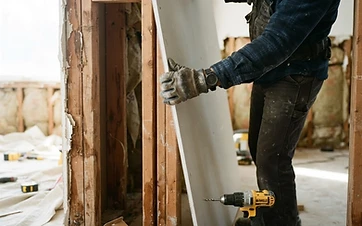
The patch is squared off to the framing, not feathered into damaged board.
- 3
Tape and three-coat
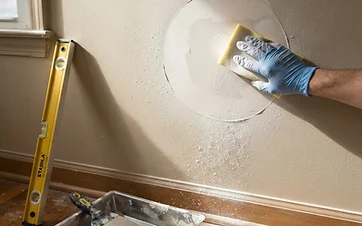
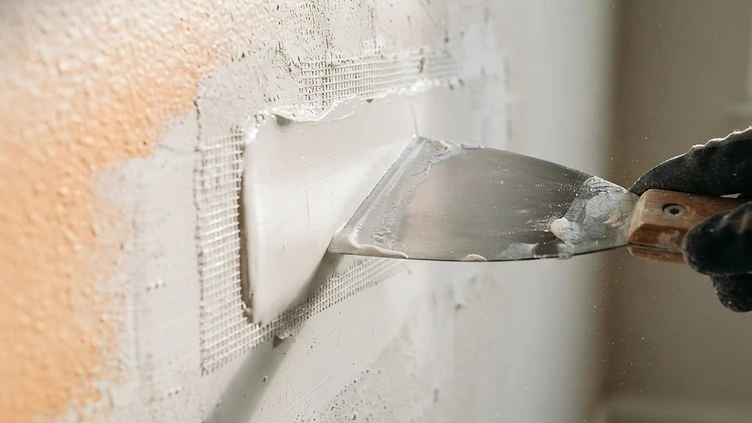
Paper tape and setting-type compound, built up in coats and sanded to a level-4 finish before texture.
- 4
Match the texture on a test panel
We spray or knife a test panel and compare it under raking light before touching the repair.
- 5
Prime the patch
Unprimed compound absorbs paint differently and flashes through the finish coat.
- 6
Blend the paint
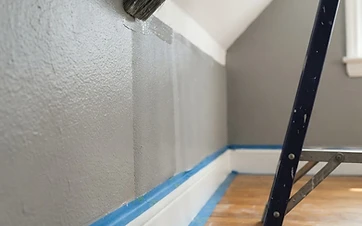
Where possible we blend to the nearest corner rather than spot-painting, so there is no hard edge.
When a repair cannot be hidden
If the wall paint has faded enough that no blend will match, or the texture was applied by hand in a pattern that cannot be reproduced, we will tell you before we start. The options are usually to paint the full wall — or the full room — or to accept a visible patch. You should be choosing between those, not discovering them afterwards.
Repairing a ceiling is a different job
Ceilings are the hardest surface to repair invisibly, because light rakes across them from below and every imperfection casts a shadow. Ceiling repairs also usually mean something happened above them — a roof leak, an AC condensate line, or a bathroom overflow. We check the cause before we patch the evidence.
What we typically see in Las Vegas homes
Based on our own repair work
From the drywall finishing we do across the Valley:
- Hand-applied textures from older custom homes are the hardest to reproduce, and we test a panel before committing to a match on almost every one.
- The single most common cause of a visible repair we are called to redo is a patch that was never primed. It flashes through the finish coat every time.
- Ceilings account for a disproportionate share of our callback corrections, because the shadow line does not forgive anything.
- Paint age catches more people out than texture. On a wall painted more than three years ago, a perfect colour match still reads as a rectangle unless it is blended to a corner.
A homeowner in Summerlin had three drywall repairs from a previous contractor that were all clearly visible in a north-facing hallway — the patches were flat where the wall was knockdown, and the paint had a visible sheen difference.
Cut all three patches back, re-taped and finished to level-4, matched the knockdown texture from a test panel, primed each patch, then blended the paint to the nearest corners across the full wall rather than spot-painting. All three repairs are now invisible in raking light.
Summerlin, Las Vegas, NV