Key takeaways
- Mould needs moisture, not humidity. In Las Vegas it comes from a water source that went unnoticed.
- The most common causes here are supply-line leaks, AC condensate lines, water heater pans and monsoon-season roof or stucco penetrations.
- Bleach and paint hide it. Neither removes it from a porous material.
Las Vegas is one of the driest metros in the country, so mould is the last thing most homeowners and landlords expect. But mould does not need humid air — it needs a moisture source, and a desert home has plenty of those hiding behind walls.
What the EPA says
The U.S. EPA is clear that moulds can grow on virtually any organic substance as long as moisture and oxygen are present, and that the way to control indoor mould is to control indoor moisture. It also notes that it is not possible to eliminate all mould and mould spores from the indoor environment — which is why the fix is always the water source, not the stain.
Source: U.S. EPA — A Brief Guide to Mold, Moisture, and Your Home
The water sources that cause mould in Las Vegas homes
- A slow supply-line or angle-stop leak under a sink, running for weeks behind a cabinet
- A toilet wax ring or shower pan failing and feeding the subfloor
- An AC condensate line draining into the wall or the return chase — the single most common cause we find
- A water heater pan overflowing, or a heater leaking at the top fitting
- A roof, window or stucco penetration letting in monsoon-season rain
- A unit left vacant through summer with the air conditioning off and a leak still running
Signs it is not a cleaning problem
- A musty smell that returns within days of cleaning
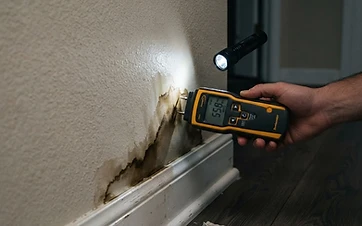
- Discolouration that spreads along a wall, baseboard or ceiling line
- Paint or texture that feels soft, bubbles, or peels away in sheets
- Dark staining on the back of drywall, on the subfloor, or on cabinet backs
- A baseboard that gives when you press it
- Occupants reporting headaches, congestion or a persistent cough that ease when they are away from the home
Any one of these is a reason to test, not to repaint. Painting over active mould seals it in and guarantees you will be doing the repair again later — at a higher cost, with people living in the space.
How remediation works
- 1
Inspection and moisture testing
We find the water source first and measure how far the moisture has travelled. This determines the real scope.
- 2
Containment
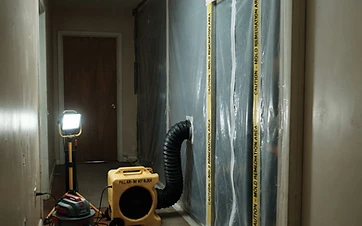
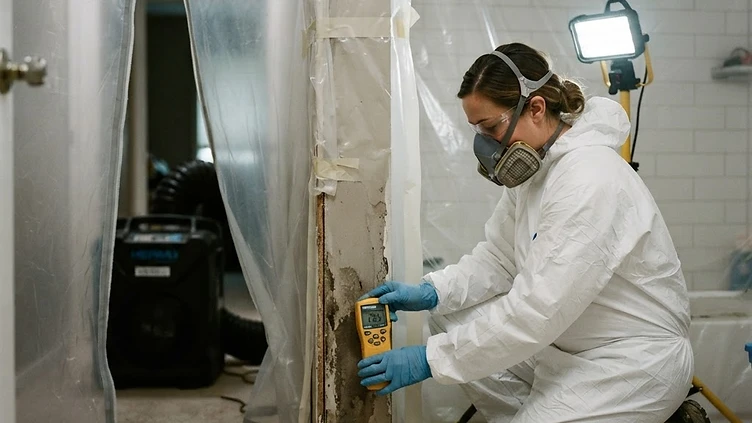
Plastic sheeting and negative air pressure seal the work area off, so spores do not spread to the rest of the home.
- 3
Removal of affected material
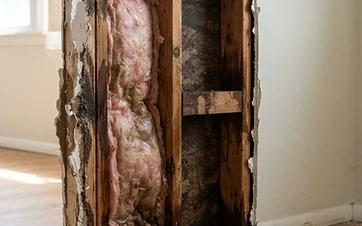
Contaminated drywall, insulation, baseboard and flooring come out. Porous material cannot be cleaned.
- 4
Treatment and cleaning
Remaining framing and hard surfaces are treated and cleaned to remove settled spores.
- 5
Drying
The cavity is dried and verified with a meter before anything is closed back up.
- 6
Reconstruction
New drywall, texture, paint, trim and flooring — done by the same company.
What not to do
- Spraying bleach on a porous surface. Bleach kills surface growth on hard materials, but it does not reach into drywall, wood or insulation.
- Painting or texturing over it. It hides the evidence and keeps feeding the problem.
- Running a fan on it without removing the water source. Air movement spreads spores instead of solving them.
Can people stay in the home during remediation?
In most single-room jobs, yes. Containment seals the work area from the rest of the home and the occupants keep the unaffected rooms. For large jobs with heavy contamination, or where the affected area includes a bedroom, bathroom or kitchen, we will tell you up front whether a temporary move-out is the safer call.
What we typically see in Las Vegas homes
Based on our own repair work
What we see across the Las Vegas Valley, from the remediations we run every month:
- The AC condensate line is our most frequent culprit. It drains for months inside a wall or ceiling before anyone notices, and it is almost always on the same wall as the air handler.
- Bathroom supply lines come second. A $15 angle stop that no longer holds is behind a surprising number of the wall-cavity jobs we open.
- Because the air here is so dry, surface mould often looks unremarkable while the damage behind the drywall is extensive. Moisture readings, not appearance, decide the scope.
- Vacant units are the worst cases. A house closed up through a Las Vegas summer with the air off and a leak still running turns a small repair into a whole-wall assembly.
A Spring Valley rental tenant reported a musty smell but no visible water. By the time we were called, a failed angle stop under a bathroom vanity had been running long enough that the drywall, insulation and baseboard behind the vanity were contaminated, and the smell had reached the adjacent closet.
Moisture-tested the assembly to establish the true extent, sealed the area with plastic sheeting and negative air pressure, removed the contaminated drywall, insulation and baseboard back to sound material, replaced the failed angle stop and supply line, treated and cleaned the remaining framing, verified the cavity dry, then rebuilt — new drywall, matched texture, primer, two finish coats, new baseboard, caulk and paint.
Spring Valley, Las Vegas, NV