Key takeaways
- Water damage is a material problem. Mould is a biological one — and it is almost always downstream of water damage that was not fully resolved.
- You can have water damage with no mould, but you rarely have mould without water damage.
- The order matters: fix the water, then remediate, then rebuild. Reversing it means paying twice.
The two get used interchangeably, and that is how people end up paying for the wrong repair. They are different problems with different scopes — and one usually follows the other.
The core difference
| Water damage | Mould | |
|---|---|---|
| What it is | Material damaged by moisture | Microbial growth feeding on that moisture |
| What you see | Staining, swelling, bubbling, soft board, warped flooring | Discolouration that spreads, a musty smell, soft or peeling surfaces |
| What you smell | Often nothing | A persistent musty or earthy odour |
| Scope of repair | Dry, remove damaged material, rebuild | Contain, remove contaminated material, treat, dry, rebuild |
| Certification needed | A licensed contractor | A certified remediator for confirmed contamination |
| Does it get worse untreated? | Yes — the damage spreads | Yes — and it can affect occupants' health |
Signs that point to water damage only
- A visible stain with no odour
- Drywall or baseboard that is damp or swollen but not discoloured
- Warped or cupping flooring
- A stain that stops growing once the leak is fixed
- Paint that has bubbled but the surface underneath is intact
Signs that point to mould
- A musty or earthy smell that returns within days of cleaning
- Discolouration that spreads outward along a wall, ceiling line or baseboard
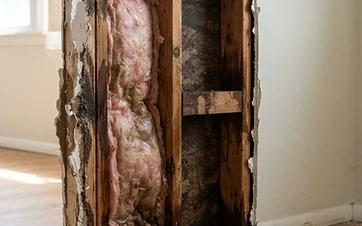
- Dark staining on the back of drywall, on the subfloor or on cabinet backs
- Surfaces that feel soft, spongy or peel away in sheets
- Occupants reporting congestion, headaches or a cough that eases when they are away
What the EPA says
The EPA notes that moulds can grow on virtually any organic substance as long as moisture and oxygen are present, that controlling indoor moisture is the way to control mould, and that it is not possible to eliminate all mould and mould spores from the indoor environment. In practice: no moisture problem, no mould problem.
Source: U.S. EPA — A Brief Guide to Mold, Moisture, and Your Home
Why the order of repair matters
- 1
Fix the water source first
Everything downstream depends on this. Remediating without fixing the source means the mould returns.
- 2
Then remediate
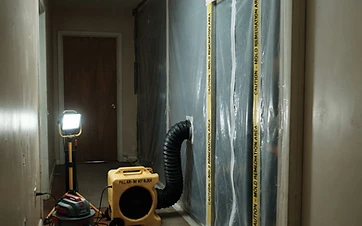
Containment, removal of contaminated porous material, treatment and cleaning of hard surfaces.
- 3
Then dry and verify
The cavity is metered until the readings hold. This is the gate before anything is closed up.
- 4
Then rebuild
New drywall, texture, paint, trim and flooring — the part that returns the room to finished.
The most expensive mistake
Rebuilding before remediating. We are called in regularly to undo a fresh drywall and paint job that was installed over a wall that was still damp and still contaminated. The new work has to come out, and the cost is roughly double.
What to do if you are not sure
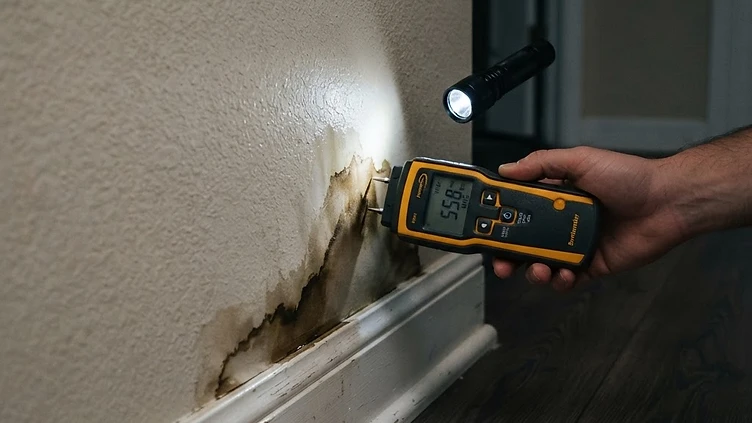
Get it assessed rather than guessed. We test moisture and inspect the assembly, which tells us whether you are looking at a drywall repair or a remediation — and that difference is usually thousands of dollars. The site visit is free.
What we typically see in Las Vegas homes
Based on our own repair work
How this plays out in the properties we work on:
- Most of the jobs we open as mould started as water damage that was dried on the surface but never verified in the cavity. The wall looked fine; the framing behind it did not.
- Odour is the most reliable single indicator. In our experience, a musty smell that returns after cleaning means growth is inside a cavity or the subfloor, not on the surface.
- Because Las Vegas air is so dry, surface mould often dries out and looks like nothing while the damage behind the drywall is extensive. Appearance is a poor guide here.
- We are asked to remediate a wall that was just repainted more often than any other single job type.
A Las Vegas landlord had a bedroom wall repainted after a leak, and the musty smell returned within three weeks. The repaint had been done without testing the cavity.
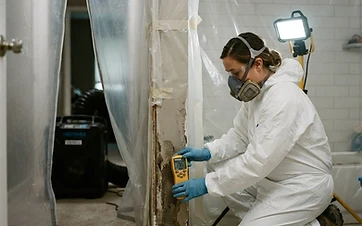
Moisture-tested the wall and found the framing and the back of the drywall were still damp, with growth on the paper. Contained the area, removed the contaminated drywall, insulation and baseboard, treated and cleaned the framing, dried and verified the cavity, then rebuilt the wall — new drywall, matched texture, primer, two finish coats and new baseboard. This time it held.
Las Vegas, NV