Key takeaways
- A slab leak rarely announces itself. It usually shows up as a water bill, a warm floor or a mystery stain.
- The line repair is a licensed plumbing job. The reconstruction afterwards is a separate scope most people forget to budget for.
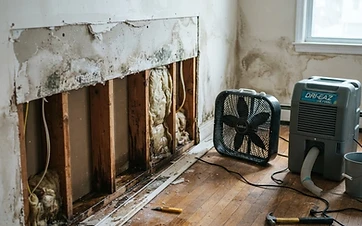
- By the time you see it on the floor, the subfloor and the bottom of the drywall are often already wet.
A slab leak is a water line under your foundation that has failed. In a Las Vegas home that line is buried in soil that expands and contracts with the heat, carries some of the hardest water in the country, and sits under a slab that holds moisture year round.
Why Las Vegas homes get slab leaks
- Expansive desert soils that shift with heat and irrigation, stressing buried pipe.
- Hard water that scales and corrodes copper from the inside over decades.
- Extreme temperature swings that expand and contract the line against the slab.
- Age. Homes built in the 1980s and 1990s are now well into the range where original lines fail.
- Poorly bedded pipe — copper in direct contact with concrete or gravel wears through.
The warning signs
- A water bill that jumps with no change in usage
- A warm spot on a tile or concrete floor — the surest sign of a hot-water line leak
- The sound of running water when every fixture is off
- Damp or dark staining on the floor, or a baseboard that has swollen
- Cracks appearing in tile or flooring that were not there before
- A musty smell in a room with no obvious source
- Mildew returning to the same spot on a wall or in carpet, again and again
- Unexplained damp patches in the yard, or a green patch in dry landscaping
The one to act on immediately
A warm spot on the floor plus a running-water sound is not a watch-and-see situation. That is an active leak under your foundation, and every day it runs adds moisture to the slab, the subfloor and the bottom of your walls.
How a slab leak is confirmed
- 1
Shut-off test
With every fixture off and the main shut, the meter should stop moving. If it does not, you have a leak on the supply side.
- 2
Pressure isolation
The hot and cold systems are isolated separately to narrow down which line is failing.
- 3
Acoustic and thermal detection
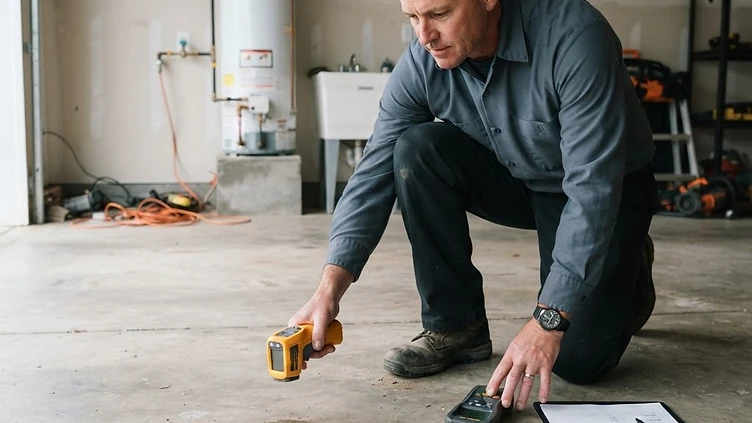
Listening equipment and thermal imaging locate the leak without breaking concrete to find it.
- 4
Moisture mapping
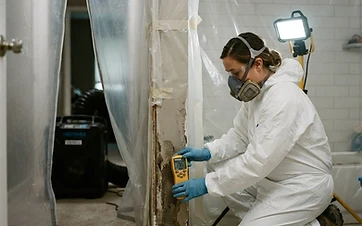
We meter the floor, the baseboards and the wall assembly to establish how far the water has already travelled.
What the repair involves
The line itself is a licensed plumbing scope, and we are straight about that: we are a general contractor, not the plumbing specialist. We coordinate the repair with a licensed plumbing partner and then handle everything that comes after, under one schedule.
- Spot repair — the concrete is opened at the leak, the section is replaced and the slab is patched.
- Reroute — the line is abandoned under the slab and run overhead through the attic or walls instead.
- Repipe — when lines are failing in more than one place, replacing the system is usually cheaper than chasing leaks one at a time.
Why the rebuild is half the job
| Stage | Who handles it | Typical duration |
|---|---|---|
| Detection and leak location | Licensed plumbing specialist | Same day |
| Line repair or reroute | Licensed plumbing specialist | 1–3 days |
| Slab dry-out and verification | Us | 2–4 days |
| Flooring removal and replacement | Us | 2–5 days |
| Drywall, texture, paint and trim | Us | 3–6 days |
What we typically see in Las Vegas homes
Based on our own repair work
What we see on the reconstruction side of slab leaks across the Valley:
- By the time a homeowner sees a warm spot or a stain, the baseboard and the bottom course of drywall are almost always wet already. The flooring and the wall are part of the scope, not an afterthought.
- Flooring rarely survives. Tile cracks along the line of movement, and plank flooring swells and separates once the subfloor is saturated.
- The homes where the rebuild goes smoothly are the ones where the dry-out was verified with a meter before anything was closed back up. Skipping that step is how the same room gets opened twice.
- We are called in most often after the plumbing repair, by homeowners who assumed the plumber's invoice was the whole cost. It never is.
A homeowner in Spring Valley had a hot-water slab leak repaired by a plumbing contractor, which left a 3-foot section of concrete opened in a hallway, damaged tile and a swollen baseboard and drywall on the adjoining wall.
Verified the slab and the wall assembly were dry with moisture readings before closing anything, removed and replaced the affected tile and underlayment, cut out and replaced the swollen bottom course of drywall, matched the wall texture, primed and blended the paint, and installed new baseboard, caulked and painted. The hallway now reads as finished rather than repaired.
Spring Valley, Las Vegas, NV